
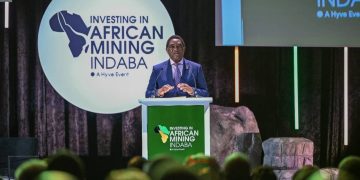


















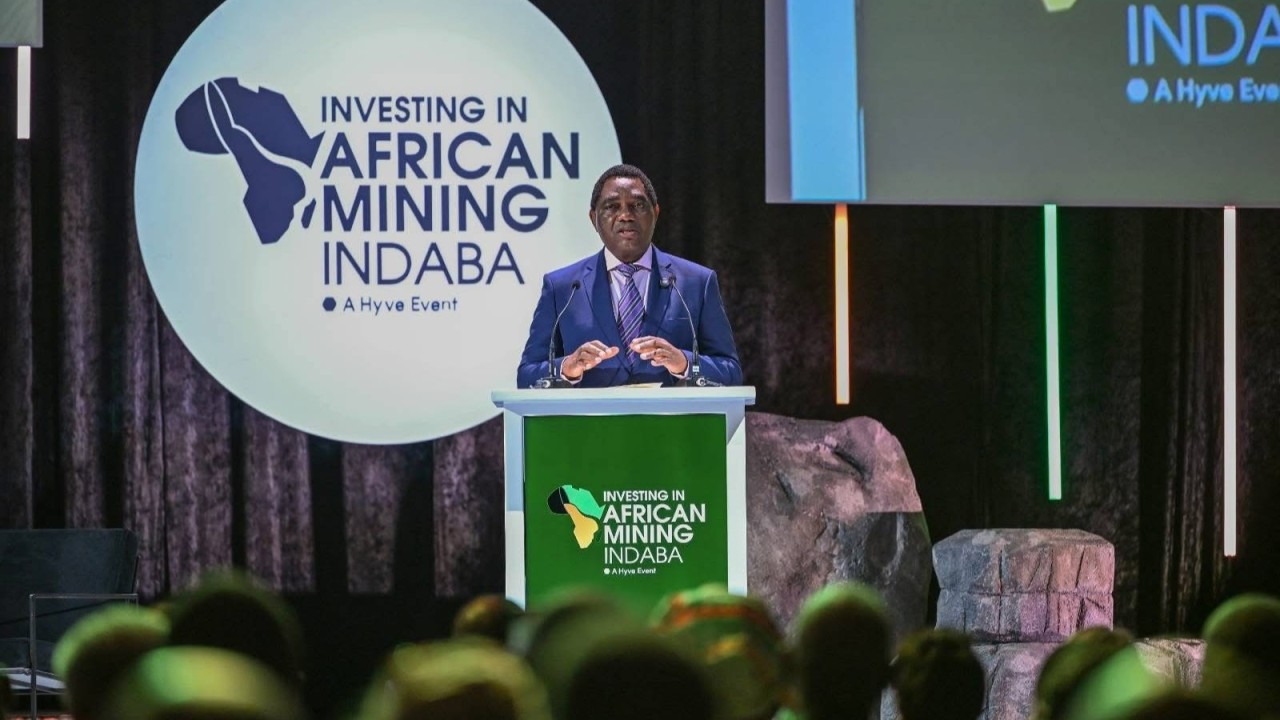
At his second Mining Indaba appearance, President Hakainde Hichilema positions Zambia as a post-default copper growth platform at the intersection of energy transition, geopolitics and infrastructure.

At the Mining Indaba in Cape Town, President Hakainde Hichilema used his second appearance since taking office to do more than restate Zambia’s mining potential. Instead, he framed the country’s reform journey as a case study in how Africa can convert natural resource endowment into credibility, capital inflows and shared prosperity, without reverting to statist instincts or extractive populism.
Standing before mining executives, financiers, policymakers and diplomats, Hichilema positioned Zambia as a country that has moved from crisis management to execution, and from sovereign distress to strategic relevance in the global critical minerals cycle.
“Africa obviously holds critical minerals. Now we know that minerals are all critical – not just for ourselves, or for the continent, but for the world,” President Hichilema said.
That framing deliberately placed Zambia, and Africa, inside the global energy transition, electrification and industrial supply-chain conversation, rather than on its margins.
From Reform Promise to Delivery
Hichilema reminded the audience that when he first addressed Mining Indaba in 2022, he did so as a newly elected president outlining an economic reconstruction agenda with mining at its core. Four and a half years later, his message was about measurable progress.
“Four and a half years down the road, I am here to say: this is how far we have gone since 2022 and where we are going from here,” he said.
Zambia inherited deep macroeconomic instability: declining GDP, elevated inflation, investor-state litigation and a mining sector paralyzed by disputes. According to Hichilema, the first phase of reform focused on restoring confidence through policy clarity, discipline and consistency.
That effort has translated into capital response. Since 2022, Zambia has attracted over US$12 billion in mining investment, spanning brownfield expansions, recapitalizations and greenfield discoveries. Copper output has risen sharply, with production up 12% in 2024 and a further 8% the year before. The country is now targeting one million tons of copper output in the near term, with a longer-term ambition of three million tons.
Sovereign Credibility and the IMF Reset
One of the most closely watched elements of Hichilema’s address was his discussion of Zambia’s engagement with the International Monetary Fund following its sovereign default.
Rejecting the narrative of externally imposed adjustment, Hichilema emphasized ownership and agency in the reform process.
“This was not an IMF programme with Zambia. It was a Zambia programme, supported by the IMF,” President Hichilema said.
For sovereign-risk and capital-markets audiences, the statement matters. It reframes Zambia’s restructuring as a proof of concept for reform-led recovery rather than austerity-driven compliance. The successful completion of the IMF programme and the country’s exit from default have materially reduced sovereign tail risk – historically the biggest barrier to long-cycle mining investment.
Mining, Partnerships and Cost of Capital
A recurring theme of the speech was partnership, across governments, investors, development finance institutions and communities. Hichilema was explicit that resources alone do not generate prosperity.
“Resources create prosperity only through strategic partnerships. Government alone is not enough – skills, capital and experience must work together,” he said.
He also addressed the structural challenge of Africa’s high cost of capital, noting that identical projects routinely price wider risk premiums on the continent than elsewhere. That, he argued, directly feeds inflation, raises operating costs and slows growth.
Zambia’s response has included regulatory reform, institutional strengthening and a state-funded, high-resolution national geophysical survey, the first in 50 years, designed to de-risk exploration and improve capital allocation.
Value Addition and the End of ‘Dig and Ship’
Hichilema was blunt on the limits of Africa’s traditional extractive model.
“Africa cannot continue exporting raw materials as the main business. We have done that for centuries,” he said.
For Zambia, value addition – through smelting, refining and downstream integration – is no longer aspirational rhetoric but part of the investment strategy. The government sees value chains not only as engines of growth and employment, but as stabilizers of the operating environment by aligning investor, state and community interests.
Mining revenues, he argued, already underpin social outcomes, including education financing and community revitalization in formerly collapsed mining towns.
Corridors, Cooperation and Regional Scale
Beyond Zambia’s borders, Hichilema emphasized regional cooperation and infrastructure corridors as economic strategy rather than logistics alone. Corridors such as Lobito and TAZARA, he argued, must evolve into industrial arteries supporting regional value chains, not merely export routes.
Africa, he said, must lead its own development agenda, inviting global partners to support clearly articulated national and regional visions rather than outsourcing strategy.
Key Take Away
President Hichilema’s Mining Indaba message was not one of perfection, but of direction. Zambia’s reforms have been difficult, often painful, and at times politically costly. But the results – capital inflows, rising output, restored credibility and renewed investor interest – are increasingly visible.
Zambia is positioning itself not simply as a copper producer, but as a reliable, reform-anchored supplier of critical minerals at a moment when global markets care as much about governance, security of supply and execution as they do about geology.
As Hichilema put it plainly:
“We are stronger together. Partnership will drive Africa’s transformation.”
For investors and policymakers alike, Zambia is no longer arguing potential. It is making a case for re-rating based on delivery.